Wednesday, February 25, 2009

It's a Wonderful Life: parking tickets in Buffalo

On my block in Buffalo, you have to park on one side of the street from Sunday to Wednesday, and the other side the rest of the week. In the handful of months I've lived here, I've gotten more than a couple citations for violating this rule, which, as I hope it goes without saying, does no good for anybody and exists to generate ticket revenue.

Last month, I was parked on the "wrong" side of the street and got two tickets in less than a day. First they left one on my windshield. Then it snowed a bunch. The diligent and scrupulous Buffalo police, not now seeing the snow-covered ticket on the windshield, went ahead and left another in the door crack.

WTF, BPD?? I was mad, but I thought I had right on my side. I photocopied both tickets, paid the first one on time, and plead innocent to the second. Today I had my hearing. I had to get up early and pay for parking by City Hall (not to mention getting lost for about 20 minutes downtown), but I was willing to accept that. This is why the hearing process exists, right? So, if silly oversights happen - like being written a second ticket by somebody who can't see that you've got one already - we can set things aright.

Nope! The woman who did my hearing smugly and coldly informed me that you can, perfectly legally, get a ticket EVERY HOUR for parking violations. "Um, I'm going to have to find you guilty." Um, I'm going to have to find you a soulless, corrupt hack. Too bad you missed your true calling as Stalin's personal secretary.

Part of me wants to protest somehow, but my beliefs in the worthwhileness of civic self-respect, of speaking truth to power, of human dignity and the spirit of fairness prevailing over the mean letter of the law, have been laid low this day.

Monday, February 23, 2009

Oh, the irony!

The Philosophical Gourmet Report, an influential and famous ranking of philosophy graduate programs based on surveys of pro philosophers, is known in some circles for its sometimes unfair or inane deliverances. Here's a good one:

My school, UB, is ranked in the 5th group (meaning rather respectable) of programs for feminist philosophy. I have no other explanation for this than confusion. Our feminist street cred? We have exactly one woman full professor, by specialty an aesthetician, who teaches a token class on de Beauvoir every so often. We have one other woman on the faculty. Neither she nor anyone else at UB works on anything you could mistake for feminism from a mile away.

On the other hand, my girlfriend's school, Michigan State, earned no ranking at all for feminism. This while their former chair (now a Dean, but still quite involved in the department) is a major and original light of feminist academe. Not to mention the big appetite for social philosophy and cross-cultural feminism they have there. No grad student in her right mind would come to UB to become a student of Carolyn Korsmeyer (with all due respect) qua feminist, but MSU, a smallish department, attracts a good handful.

Another reason to roll your eyes at this stuff, dear Integrands...

Asia wins again! (a perfect pitch experiment)

In a crazy study (well, a normal study with crazy results) conducted by some folks at UC San Diego, it was found that music students who grow up speaking toned languages, like Mandarin Chinese, are whoppingly more likely to have perfect pitch than non-toned speakers.

(A toned language is one where the pitch of spoken words partly determines their meaning.)

The foci of the study were groups of young adult music conservatory students in the U.S. and China. The difference in perfect (or "absolute") pitch possession, where both groups had begun musical training between the ages of 4 and 5 was... ready?...

74% for Mandarin speakers vs. 14% for Westerners.

And here we all thought only a few special ingenues could do that. The authors suggest that, contrary to what most of us thought, most anyone can acquire perfect pitch if they are exposed to performatively important tone differences in their early years. Want to raise a Mozart? Try hiring a Chinese nanny.

The paper, by the way, is here.

Sunday, February 22, 2009

Learn from the Tao

Tao Te Ching XIII:

Pride and shame cause us much fearful anxiety.

But our inner peace and distress should be our primary concerns.

Why do pride and shame cause us so much fearful anxiety?

Because:

Pride attaches undue importance to the superiority of one's status in the eyes of others;

And shame is fear of humiliation at one's inferior status in the estimation of others.

When one sets his heart on being highly esteemed, and achieves such rating, then he is automatically involved in fear of losing his status.

Then protection of his status appears to be his most important need. And humiliation seems the worst of all evils.

That is the reason why pride and shame cause us so much fearful anxiety.

[The Tao Te Ching gives me solace when I feel "fearful anxiety".]

Let's talk about quanta, baby.

Dear Integrands, you are in for a treat. I am thinking of a little series on the subject

Quantum Mechanics for Everyone

which you will enjoy.

Deep down inside, everybody has a part of themselves that wishes they understood more about basic modern physics. (I know I do, and we're all basically the same, right?) It is a noble wish--but for most of us it is only that. It is hard to learn these things on one's own. They make it hard.

There is Them, gentle Integrands, and there is me. I am here to indulge your deep, dark, frustrated desires. To whisper in your ear the equations you have longed for. Let's start off with an easy one!

Today's Topic: The Uncertainty Principle

I think you have heard of this before? It is a very deep fact that requires very little math. It is wonderful and mysterious. It looks like this:

If you inspect the formula carefully, you will be pleased to fail to discover any calculus, or matrices, or complex numbers, or really anything to put you in a distemper.

Let's read it in English, shall we?:

Delta-x times delta-p is greater than or equal to h-bar over 2.

Which means more or less this:

When you measure a quantum system, the amount of uncertainty about its position times the amount of uncertainty about its momentum must be greater than or equal to a certain number (the reduced Planck constant divided by two).

Huh?

Let's talk about this. Maybe you have questions? Good, I like answering questions.
  1. A quantum system is an atom, or a subatomic particle (an electron or proton, for example). It may also be a collection of atoms or particles that are grouped together and interacting with each other. Quantum mechanics is all about the behavior of these little creatures.
  2. The uncertainty of a measurement is just what it sounds like. It is the "amount of our unsureness" that our measurement was exactly right.
  3. The position of a quantum system is another easy one. It is the point where the thing is located in three-dimensional space. We represent it with an ordered triple (x, y, z), which is a way to pick out a point on a 3-D graph.
  4. The momentum of a quantum system is the direction it is headed, and the magnitude with which it is heading there. We represent it by a vector, which is an arrow of a certain length on a graph.
  5. H-bar (the dashed 'h') is a number. It is a form of the number called "Planck's constant", which basically is the "size" of a quantum of energy.
Dear reader, you are on the doorstep of understanding. All that's left is to put these ideas together.


There you are, looking for your lost electron. Where could it be?, you ask. Where is it going? The uncertainty principle tells you--alas!--that you can't answer both questions very exactly at once. The product of your position-uncertainty and your momentum-uncertainty must be bigger than a certain fixed amount. If you are quite sure where your electron is, you cannot be very sure where it is going. In fact, there is no possible experiment, even with the most sensitive and exact equipment anyone could make, that can tell you both with complete accuracy at once.

Congratulations! Now you understand the Uncertainty Principle of quantum mechanics. Be sure to tell your friends!

Saturday, February 21, 2009

The integral sign: a life


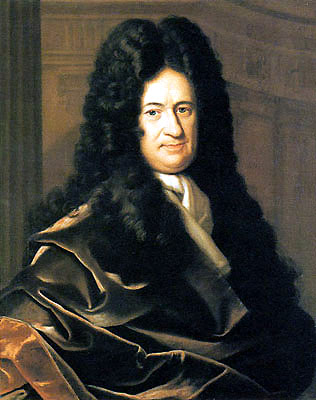
The curly S integral sign, ∫, was made up by the German polymath Gottfried Wilhelm von Leibniz in the 17th century. An S was chosen because an integral is a limit of sums.

See the S?

Sums

Leibniz was a unique and prolific thinker. (We are glad to have him as our patron saint.) Among his frequently strange views, he believed that ours is the best of all possible worlds. I myself believe that his was the best of all possible wigs.

Hello!

Well, here we are. The first post of my first blog. Welcome and thanks for reading!

INTEGRAL is so-called because it will sum up the area under my life-experience curve, as it were. Also because it will integrate a variety of subjects. Then again because it will prove integral (ha, a pun!) to its readership.

INTEGRAL will be "idio-syncretic". Idio, because it will reflect my peculiar concerns and experiences--syncretic, because it will assimilate a lot of different stuff to one unifying structure, or position, or viewpoint.

Some of the things I foresee writing about are: philosophy, math things, books I'm reading, poems, neat proverbs and aphorisms, science, interesting ideas of any kind, autobiographical things. This list may or may not be very accurate. I suspect there are other rabbits hiding in the hat.

Although this blog is a kind of personal chronicle, it is also supposed to be eclectic and representative of thought-chunks of many shapes and sizes. So I encourage comments and even guest contributions.